Intranet vs Communication Platform - Compare | LoopB
Intranet vs Communication Platform - Compare | LoopB
Intranet vs Communication Platform - Compare | LoopB
There's a file somewhere on your company intranet. Uploaded in 2022. Nobody knows who put it there. Nobody has opened it since.
That's not an edge case. That's the intranet experience at most companies, right now.
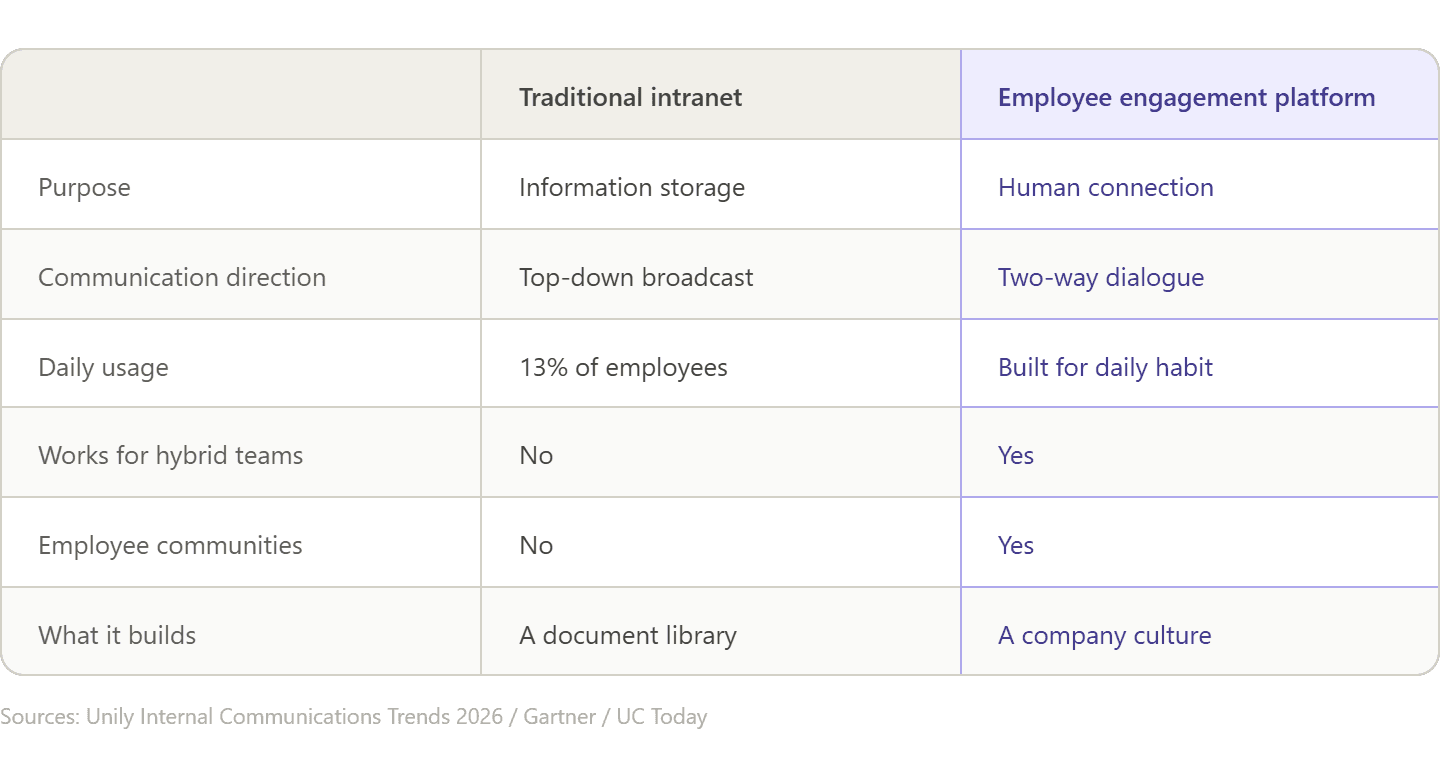
Only 13% of employees use their company intranet daily. The other 87% have simply stopped showing up. Not because they're disengaged, but because the tool never gave them a reason to come back.
What Traditional Intranets Were Never Built to Do
The intranet was designed for storage, not for people. Policy documents, org charts, the cafeteria menu from last spring. Information architecture, not human connection.
That worked when everyone sat in the same building. It stopped working the moment work became distributed and cross-functional.
Employees don't need another place to find a PDF. They need a place where they feel like they're part of something. Those are very different problems. They need very different tools. Also see, Why Intranets Fail - Top Mistakes To Avoid
Why Adding More Tools Won't Fix Your Intranet Problem
Most companies know their intranet isn't working. But the default fix is to add to the stack rather than rethink it. A Slack channel here. A Teams announcement there. An email blast when something actually matters.
The result: information scattered across five platforms, updates that never reach everyone, and a workforce that's technically connected but doesn't feel it.
According to Unily's 2026 Internal Communications Trends report, fragmented communication is now one of the top drivers of employee disengagement. Not the work itself, not the manager. The medium.
What's Different About Internal Communications in 2026
Hybrid work is no longer a transition. It's the baseline. Intranets built for office-first teams were already struggling. For distributed teams, they're functionally useless.
Retention has also become a board-level priority. The cost of replacing a single employee ranges from 50% to 200% of their annual salary, according to analysis from Gartner and UC Today. Quiet disengagement is no longer a soft culture issue. It's a financial one.
Related read: What Is Quiet Quitting And Why Should You Care Before It's Too Late?
There's a file somewhere on your company intranet. Uploaded in 2022. Nobody knows who put it there. Nobody has opened it since.
That's not an edge case. That's the intranet experience at most companies, right now.
Only 13% of employees use their company intranet daily. The other 87% have simply stopped showing up. Not because they're disengaged, but because the tool never gave them a reason to come back.
What Traditional Intranets Were Never Built to Do
The intranet was designed for storage, not for people. Policy documents, org charts, the cafeteria menu from last spring. Information architecture, not human connection.
That worked when everyone sat in the same building. It stopped working the moment work became distributed and cross-functional.
Employees don't need another place to find a PDF. They need a place where they feel like they're part of something. Those are very different problems. They need very different tools. Also see, Why Intranets Fail - Top Mistakes To Avoid
Why Adding More Tools Won't Fix Your Intranet Problem
Most companies know their intranet isn't working. But the default fix is to add to the stack rather than rethink it. A Slack channel here. A Teams announcement there. An email blast when something actually matters.
The result: information scattered across five platforms, updates that never reach everyone, and a workforce that's technically connected but doesn't feel it.
According to Unily's 2026 Internal Communications Trends report, fragmented communication is now one of the top drivers of employee disengagement. Not the work itself, not the manager. The medium.
What's Different About Internal Communications in 2026
Hybrid work is no longer a transition. It's the baseline. Intranets built for office-first teams were already struggling. For distributed teams, they're functionally useless.
Retention has also become a board-level priority. The cost of replacing a single employee ranges from 50% to 200% of their annual salary, according to analysis from Gartner and UC Today. Quiet disengagement is no longer a soft culture issue. It's a financial one.
Related read: What Is Quiet Quitting And Why Should You Care Before It's Too Late?
Try LoopB Free Now!
Try LoopB Free Now!
LoopB empowers employee engagement in modern organizations. Culture is no longer left to chance.
LoopB empowers employee engagement in modern organizations. Culture is no longer left to chance.
What a Modern Employee Engagement Platform Looks Like
The companies moving away from traditional intranets aren't just switching tools. They're switching the model entirely — from broadcasting to belonging.
The best employee communication platforms don't push information at people. They create a space employees actually want to come back to. Updates that feel like news, not notices. Communities built around shared interests, not just org charts.
The difference, as one communications leader put it in Poppulo's 2026 report, is the shift from "we posted it" to "they saw it, and they responded." That loop is what the intranet was never designed to complete.
LoopB is built for exactly that. Not a replacement for your tools. A home for your culture.
How to Evaluate Intranet Alternatives: Key Questions to Ask
Does the platform support two-way communication, or is it still just broadcasting? Can employees find and follow communities that matter to them? Does the feed surface things people actually care about?
These aren't feature questions. They're culture questions.
Frequently Asked Questions
What is an employee communication platform?
An employee communication platform is software that enables two-way communication across an organization, giving employees a place to share updates, join communities, and stay connected with their company culture. Unlike a traditional intranet, which distributes information top-down, an employee communication platform is built around dialogue, not broadcasting.
What's the difference between an intranet and an employee engagement platform?
An intranet is designed for information storage and retrieval: policy documents, org charts, company announcements. An employee engagement platform is built to create ongoing connection between employees, teams, and leadership. Intranets push information out. Engagement platforms make space for a response.
Why are companies replacing their intranet in 2026?
Intranet adoption has collapsed. Only 13% of employees use theirs daily. Distributed teams, hybrid schedules, and a workforce that expects to be heard have made the old model obsolete. Companies replacing their intranet are looking for platforms that support real dialogue, not just document storage.
Stop fixing your intranet. Start building connection.
Sources: Unily Internal Communications Trends 2026 · Gartner Future of Work Trends for CHROs · UC Today Employee Experience Trends 2026 · Poppulo: Beyond Trends 2026 · The Great Displacement: 2026 Unified Engagement Platforms Study
What a Modern Employee Engagement Platform Looks Like
The companies moving away from traditional intranets aren't just switching tools. They're switching the model entirely — from broadcasting to belonging.
The best employee communication platforms don't push information at people. They create a space employees actually want to come back to. Updates that feel like news, not notices. Communities built around shared interests, not just org charts.
The difference, as one communications leader put it in Poppulo's 2026 report, is the shift from "we posted it" to "they saw it, and they responded." That loop is what the intranet was never designed to complete.
LoopB is built for exactly that. Not a replacement for your tools. A home for your culture.
How to Evaluate Intranet Alternatives: Key Questions to Ask
Does the platform support two-way communication, or is it still just broadcasting? Can employees find and follow communities that matter to them? Does the feed surface things people actually care about?
These aren't feature questions. They're culture questions.
Frequently Asked Questions
What is an employee communication platform?
An employee communication platform is software that enables two-way communication across an organization, giving employees a place to share updates, join communities, and stay connected with their company culture. Unlike a traditional intranet, which distributes information top-down, an employee communication platform is built around dialogue, not broadcasting.
What's the difference between an intranet and an employee engagement platform?
An intranet is designed for information storage and retrieval: policy documents, org charts, company announcements. An employee engagement platform is built to create ongoing connection between employees, teams, and leadership. Intranets push information out. Engagement platforms make space for a response.
Why are companies replacing their intranet in 2026?
Intranet adoption has collapsed. Only 13% of employees use theirs daily. Distributed teams, hybrid schedules, and a workforce that expects to be heard have made the old model obsolete. Companies replacing their intranet are looking for platforms that support real dialogue, not just document storage.
Stop fixing your intranet. Start building connection.
Sources: Unily Internal Communications Trends 2026 · Gartner Future of Work Trends for CHROs · UC Today Employee Experience Trends 2026 · Poppulo: Beyond Trends 2026 · The Great Displacement: 2026 Unified Engagement Platforms Study


Recommend For You
Recommend For You
Recommend For You

Employee Experience Platform - What It Is and How to Choose One in 2026 | LoopB
Employee Experience Platform - What It Is and How to Choose One in 2026 | LoopB

Employee Engagement App - Why Your Frontline Needs One in 2026 | LoopB
Employee Engagement App - Why Your Frontline Needs One in 2026 | LoopB

Generations in the Workplace - How to Lead a Multigenerational Team in 2026 | LoopB
Generations in the Workplace - How to Lead a Multigenerational Team in 2026 | LoopB

Product
Industries